

NEWPORT — The Memphremagog Science & Education Center (MemSEC) celebrated its grand opening Saturday evening, marking a major milestone for environmental education in the Northeast Kingdom.
The event, held from 4-7 p.m. at the center’s location in the upper level of Newport’s Gateway Center, featured speeches and a ribbon cutting ceremony, light refreshments, interactive exhibits, and interpretive panels in English and French.

Douglas Casson Coutts, who helped develop the center after four decades in international community development, addressed attendees about the project’s origins and mission.
“Invest in the youth, educate them and help them appreciate their community – economic, social development will follow,” Coutts said during his remarks. “We preserve what we love. We protect better what we know.”
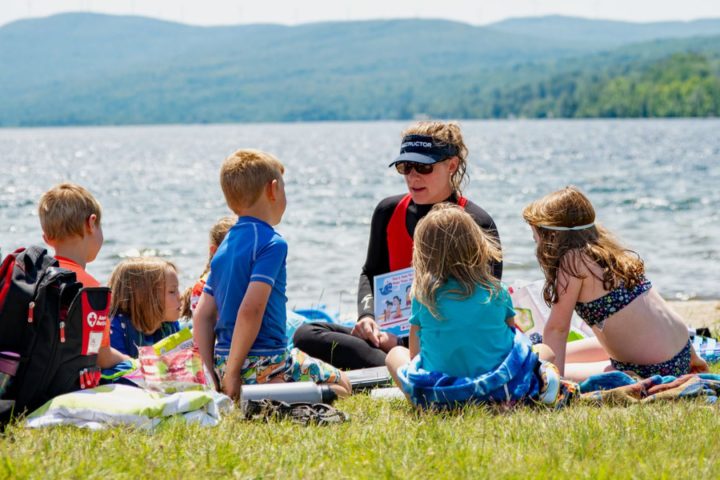
Coutts explained that the center began as an idea to expand the floating classroom program that launched in 2018 aboard the Northern Star vessel. The educational programs have shown significant growth, with 468 students participating in floating classroom experiences in 2023 and 2024.
“Ten years ago, a year after I retired and returned from my last posting in Africa, I joined this team working to keep the Northern Star in Newport,” Coutts said. “I saw our boat as a ‘means to an end’ – get our students out on the water to learn about our watershed and the importance of what we have here.”
The center now serves as a year-round learning facility that complements the floating classroom program. John Aldridge, director of MemSEC, was introduced during the ceremony as the leader who will guide the center’s educational programs going forward.
Aldridge said the goal and intention with developing this space was to create a year-round opportunity for people to engage with the natural world.
Aldridge described the center as having a “modular sort of system” that allows the space to be reconfigured for different needs, from public exhibits to school groups to meetings with collaborative partners in outdoor recreation or conservation.
The center features interpretive panels covering topics including the formation of Lake Memphremagog, upland and aquatic habitats, and information about the Abenaki tribe of Odanak, detailing “the original inhabitants of this landscape, their way of life, and how that way of life changed over time,” according to Aldridge.
Interactive features include a stream model that allows visitors to experience stream formation, erosion and deposition firsthand, and an augmented reality sandbox utilizing Xbox 360 scanners and projector technology to create topographic maps.
“It’s really wonderful for students and participants to have their hands in actual earth materials to learn about some of these ecological processes that affect our world,” Aldridge said. “As we know, a healthy river and a healthy lake, it all starts upstream. So the decisions that we make upstream in a watershed result in the quality of the water that we have in the lake.”
Coutts acknowledged the Abenaki territory during his opening remarks, stating: “We acknowledge that we are gathered on the traditional, ancestral, and unceded territory of the Abenaki People. We recognize their ongoing connection to this land and their stewardship of it since time immemorial.”
The center was developed with funding from the Vermont Community Foundation through its Better Places program, the Vermont Housing and Conservation Board, and the Great Lakes Fishery Commission. Coutts thanked Senator Bernie Sanders and his staff for their early support of the project.
“In non-profit organization world, the hardest task is to land the first grant,” Coutts said. “A special shout out to Sen. Bernie Sanders – he and his staff believed in us!”
The floating classroom program now serves numerous local schools including Newport City Elementary, Derby Elementary, Troy School, along with Coventry, Irasburg, Brownington and Barton, with plans to expand to Quebec schools through their partnership with COGESAF.
Recent funding has helped eliminate financial barriers to the program. “We’ve actually eliminated some barriers for affordability to make it more possible than ever. So we’re actively recruiting for school groups in the Northeast Kingdom and in southern Quebec. And we’d love to make this program available to all students,” Aldridge said.
Coutts emphasized the center’s importance for regional youth and future stewardship of the shared international watershed.
“Doesn’t matter what us grey haired folks think, need or want – we’ll soon pass on, what matters are our youth,” he said. “They are the ones who will decide in the future.”
MemSEC is now open as a community learning center, with Coutts noting it was “built by the community, for the community.”